Pages

30 Dec 2014

diy: bench cushion cover made from IKEA 'Signe' cotton rugs


When you look at the frequency of my blog posts,you probably can tell, with just 2 weeks (!) left to 'd-day' I'm more active than ever. I spend almost every day behind my sewing machine, working on baby-related and other projects, running up-and-own the stairs and just not sitting on my butt... The days just seem to fly by. I think every day that I really, really should pack a hospital bag, but on the other side, I don't experience early signs like Braxton-Hicks contractions and I don't expect the baby popping out just like that...

People around me say this is the 'nesting instinct', and I'm definitely feeling very energetic and productive these days and I do have an urge to organize and finish unfinished projects. I can't complain, I have no annoying pregnancy symptoms at all, besides quite frequent trips to the bathroom and tired legs at the end of the day from running around... But: no back pain, no swollen legs, no heartburn, and I don't even need a nap during the day!
Let's be honest, working on fun and creative projects is still better than cleaning the house all day long, right?


We have a teak wooden outdoor bench at the dinner table which we use a lot. Up until now we've kept the original seating cushions (just because it was easy) which were quite ugly yellow and red colored, and even after several attempts to have them cleaned remained stained.
Lately, I've visited a nearby IKEA store quite a few times to buy baby-related items (like my fav. project-bathtowels) I came across these cotton rugs. They only had a few left-overs with brown stripes. For 1.49 euro a piece I thought it was a bargain and I took 4 of them. The idea was to use them for the bench.


As you can see the rugs have a rustic texture and they are not perfect (like the stripes don't match perfectly) but they are really sturdy, so ideal for intensive use:


material & sizing:
my finished size: approx. 50cm x 145 cm
- 4 IKEA 'Signe' woven cotton rugs
- 1 meter of IKEA 'Minna' fabric for the back
- mattress for cushion stuffing

step-by-step:
I didn't make step-by-step pictures this time, but what I did was:
- cutting off the shorter, knotted edges, and then zigzagged them to prevent fraying.
- then I sewed two rugs together, pressed and steamed the seam and then strengthened the seams with topstitching on both sides of the seam.
- I used IKEA's sturdier cotton 'Minna' fabric for the back with an overlapping seam and simple velcro closure.
- I kept the rugs as long as possible and folded under, so it looks good from the sides too! (= the back fabric is shorter than the front)
- For the stuffing I simply recycled the old mattresses (complete with cover and all) and made the new cover a bit smaller (both in length and width) for a nice, firm look.


Below is another project from a few days ago, the roman blinds which were lying around for about a year of 1.5?... I wrote about how to make those here.
The total look is much more cleaner and coordinated (until we saved enough money to have the bay-windows placed instead of the old window...)

29 Dec 2014

diy: hooded baby bath cape


material & sizing:
Finished size: 75x75 cm (29 1/2 x 29 1/2")
- 1 IKEA Haren bathtowel 100x140cm (39x59") surface density: 400g/m2 (1.31 oz/sq ft)
- about 260 cm bias tape (approx. 102")
optional: leftover fabric for front of hood


step-by-step:
1. cut a 75x75 cm square main piece (no seam allowances needed!)
2. draw rounded corners with a small size plate (mine has a diameter of approx. 10 cm = 4")
3. cut and a triangle for the hood. My triangle measures 19 cm (=7 1/2") from the rounded top to the center of the long side.
(If you want to add another fabric layer to the front cut another triangle. I used my trusty cotton waffle fabric, but you can use any other printed fabric too.)


4. if you have more layers for the hood, pin and stitch the layers of triangles together (this prevents the layers from shifting when attaching the bias tape)

First finish the edge of the long side of the triangle hood:
5. press one side of the bias tape slightly open, this makes it easier to place.
6. pin it with the open side to the edge on the wrong side and stitch.
7. trim about 1/2 of the seam underneath the bias tape to reduce bulking.


8. press seam flat from the right side, then turn wrong side up (you can see the trimmed seam below at right):


9. fold the bias tape in half (the edge should meet the stitch line) press and pin:


10. sew the bias tape in place on the right side with a small topstitching:


11. Pin the triangle for the hood in place:


12. attach the bias tape all around as described above (steps from 5 to 10)
Al the layers are going to be thick, so carefully trim after sewing:


don't forget to slightly stretch the bias tape when pinning around the corners!


13. ready!


I made two of these bath capes today:

27 Dec 2014

inspiration: padded Canadian smocking pillow


A really interesting (and actually quite simple) technique demonstrated by debbie shore!

26 Dec 2014

diy: patchwork jeans pillow cover


the cover can be used with both sides, the front is rough and the back has a clean and geometric look:


material & sizing:
- old pair of jeans or (leftover) pieces of jeans fabric
- zipper of 40 cm
- inner cushion
trick:
use the IKEA 'GOSA SLAN' pillow  which is cheaper (1.99 euro's) and has more filling (450g) than the 'INNER' cushion (2 euro's and 350g) and is easy to shorten to 50x50 cm (20"x20")
step-by-step:
I used jeans fabric to make this project, since I had no old pair of jeans on hand and this was a very last-minute project to create a Christmas gift for a teenage boy.

1. Make the 'clean' side first, by cutting large, rectangular pieces (don;t forget to add seam allowances all around) For the 'rough' side you can use scrap fabric too, but you need to have larger pieces for this. Sew the pieces together to a size of 50x50 + seam allowances all around! (I always use the standard 5/8 or 1.5 cm)
Finish all seam allowances and use a small topstitching on the seams:


2. Cut up the pair of jeans or jeans fabric into stripes of different widths, in different directions. I used fabric stripes about 30 cm and not shorter than 20 cm. (no pics of this step because I was working on it at nighttime...)

3. Cut the stripes into squares and rectangular pieces of different widths, then sew them back together, placing wrong sides together and swing on the right side. I used a seam allowance of approx. 0.5 cm (= 1/8").
By the way, I did for the patchwork-side of the cover everything 'freehand', no super straight lines, no pinning, no precise seams or anything.


4. Te fun part: assemble your 'puzzle' of fabric stripes! don't be afraid of cutting pieces off or adding strangely shaped pieces of scrap fabric to fill up the empty spaces. When sewing you can fold the seams to one side or press them open:


5. Cut to size (50x50 cm + seam allowances all around)
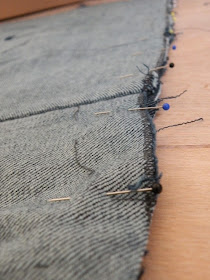
Press from the back. Check for holes like below. Close them from the right side. (here is a strange little corner which is open):


6. Before assembling finish seam allowances on the outer edges, I used a simple zigzag stitch. Another fun part: make your patchwork piece wet and put it in the dryer. This causes the edges unravel further and makes the  loose fibers swell giving a nice, 'fluffy' surface. If you aren't satisfied repeat.

7. Roughly cut away the horizontal (white) threads along the seams. Press from the back.

8. Pin front and back and sew (leaving place on one side for the zipper). No problem if your patchwork piece doesn't have perfectly straight edges, you can gently pull it in shape or just leave it like that. Reinforce corners by going back-and forth a few times when sewing.


9. Clip the corners and finish cut edges:


10. Press seam allowances open at the opening and insert a simply lapped zipper:


11. Ready!


24 Dec 2014

A quick knit: chunky wool pillow cover


It took me just one evening to knit this chunky cushion cover front and a couple of hours to make the actual cover and sew the front panel on it.


material:
'Marl wool' color nr.1 (off white) from Zeeman. 50% acrylic + 50% wool
per skein: 100g=100meters (2.79 euro's)
used 230g for a 50x50 cm cushion cover front (total costs about 6.50 euro's)


I used two strands of yarn. Started with 42 sts and worked in q simple stocking stitch. After approx. 55 rows the cushion front was ready!
I used a circular knitting needle, about metric size 8 (I guess) and worked loosely.
 I made a separate full cushion cover, the back is made from a left-over piece of off-white IKEA 'Mette' fabric, for the front lining I used of a left-over piece of cheap off-white muslin fabric. After finishing sewing the cover I handsewn the knitted panel onto the front, starting with the top and bottom part and then sewing the sides.

pinning and stitching the top:

the bottom part at the opening:


the knitted cover is slightly smaller in the length since knits tend to stretch out: